

Do all septic systems have a pump?
- Ajasa Samuel
- 2 days ago
- 4 min read

No. Plenty of septic systems in Middle Georgia have never had a pump and never will.
Whether yours needs one comes down to a question you can answer by standing in your yard and looking at it: is your drain field downhill from your house? If it is, gravity does the work for free. If the drain field sits uphill, or across a rise, or far enough away that the fall runs out, something has to push the effluent, and that something is a pump.
We get asked this a lot by people buying rural property who have just been told their quote includes a pump tank and want to know whether they are being upsold. Usually they are not. Usually the land decides it.

How a gravity septic system works
A gravity system has two parts and no moving pieces worth mentioning.
Waste leaves the house through the sewer line and enters the septic tank. Inside the tank, it separates. Solids sink into a sludge layer at the bottom. Grease and light material float to the top as scum. The relatively clear liquid in the middle, called effluent, is what leaves the tank.
That effluent flows out through the outlet tee and into the drain field, sometimes called the absorption field or leach field. The drain field is a set of trenches filled with gravel or chambers, holding perforated pipe. Effluent trickles out of the pipe, moves down through the gravel, and enters the soil. The soil does the actual treatment. Bacteria in the top layers break down what is left before the water reaches groundwater.
The whole thing runs on fall. You need a consistent downward slope from the house to the tank, and from the tank across the drain field. No electricity, no controls, nothing to fail in a storm.
That last part matters more than people expect. A gravity system keeps working during a power cut. A pumped system does not, and if the power stays off long enough the pump tank fills and backs up toward the house.
When you need a pump
Four situations put a pump in your quote.
The drain field is uphill from the tank. This is the common one. Plenty of Baldwin and Putnam County lots have the only suitable soil sitting above the house site, because the low ground is too wet or too close to a creek.
The drain field is a long way off. Even downhill, a run of several hundred feet can use up all your available fall before you reach the field.
You are on a system that requires dosing. Drip dispersal and mound systems do not work on gravity flow. They need pressure to distribute effluent evenly across the field, and pressure means a pump.
The house has a basement bathroom below the tank inlet. Then you need a grinder or effluent pump just to get waste up to the tank.
What is a dosing tank in a septic system?
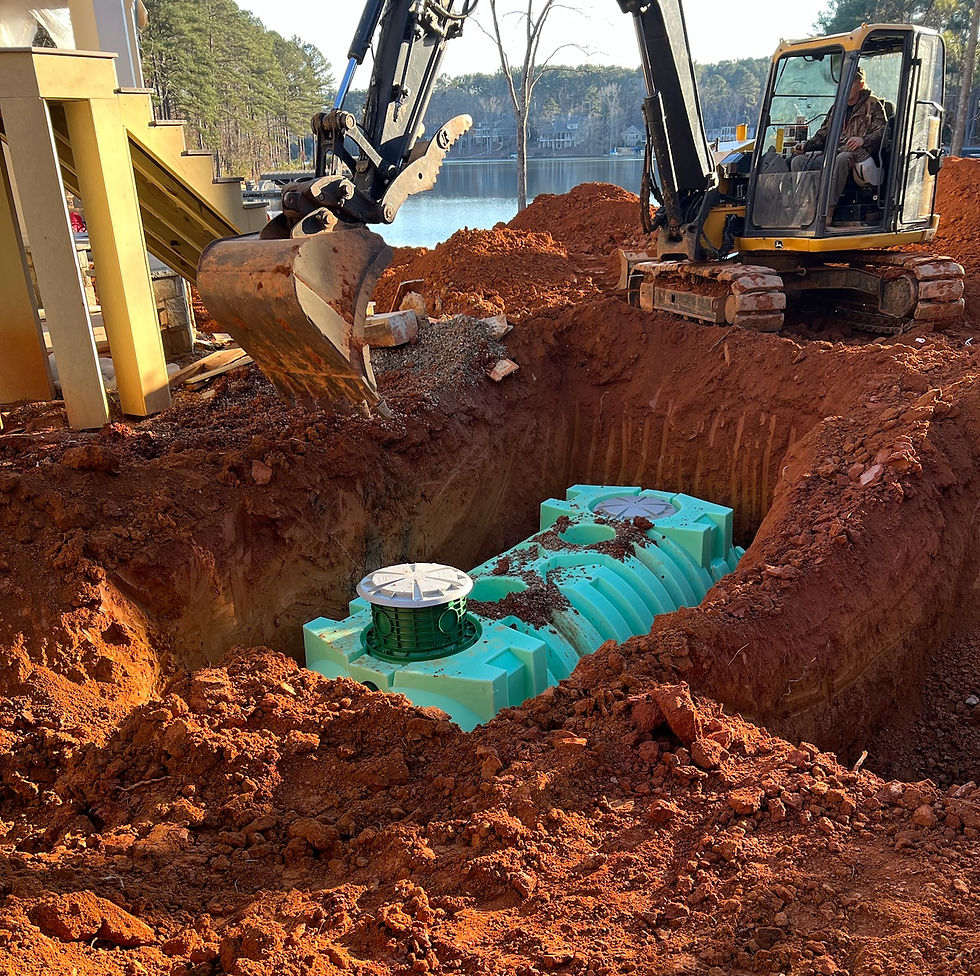
A dosing tank, also called a pump tank or lift station, is a second tank that sits between the septic tank and the drain field. It holds a pump, a float switch or pressure sensor, and a control panel somewhere nearby.
Here is why it exists. Effluent leaves the septic tank continuously, in dribbles, every time somebody flushes or runs a tap. If you pumped that dribble straight to the drain field, the same few feet of trench nearest the inlet would take all of it, day after day, and eventually clog with biomat while the rest of the field sat dry and unused.
The dosing tank fixes that by batching. Effluent collects until the float reaches a set level, maybe 50 or 100 gallons depending on the design. Then the pump fires and delivers the whole dose at once, fast enough and with enough volume to fill the distribution lines and spread across the entire field. Then it shuts off and the field gets a rest period to drain and re-aerate.
That rest period is the point. Soil treats wastewater aerobically, and it needs air between doses to do it. A well-designed dosing cycle gives the field a chance to breathe.
Most dosing tanks also carry a high-water alarm. If the pump fails, the alarm sounds before the tank overflows, which usually buys you a day or two to get somebody out.
What this means for your budget and your maintenance
A pumped system costs more up front. You are buying a second tank, a pump, a control panel, an electrical run to the panel, and the labor to set all of it.
It also costs more over time. Pumps wear out. Depending on the pump, the water, and how hard it runs, expect to replace it in about a decade, sometimes sooner. Control panels take lightning hits. Float switches stick.
None of that makes a pumped system a bad system. It makes it a system with a maintenance schedule. If your site needs one, it needs one, and trying to force gravity where the land will not give it to you produces a field that fails in three years instead of thirty.
What you should not accept is a pump you do not need. If your drain field area is downhill and close, ask why the design calls for one.

Finding out which one your site needs
You will not know until the soil work is done. A certified soil classifier or your county Environmental Health office evaluates the soil on the actual drain field location, checks the depth to any restrictive layer or seasonal water table, and sets the required field size. Where that field ends up sitting, relative to your house, determines whether gravity or a pump is used.
Area Solutions installs both across Middle Georgia. If you are working out what a piece of land will take before you buy it, or you have a system that is not draining the way it used to, call Owen at (478) 251-5800.
Comments