

Septic Tank Installation in Milledgeville, GA: What Every Property Owner Needs to Know
- Ajasa Samuel
- Mar 13
- 7 min read

Serving Baldwin County, Jones County, Putnam County, and all of Middle Georgia
If you're on a property outside city sewer lines in Middle Georgia, your septic system isn't just a detail, it's the whole show. Get it right and you forget it exists for decades. Get it wrong and you're looking at a flooded yard, a failed inspection, or a repair bill that makes you wish you'd called the right crew the first time.
Area Solutions has done a lot of digging across Baldwin County and the surrounding counties. Septic installs. New construction hookups. Drain field excavation. Site prep for folks building out in the country where the county sewer doesn't reach. We've seen what happens when it's done right, and we've seen what happens when it isn't.
This article covers what you need to know before you put a shovel in the ground; soil types, system sizing, Georgia Health Department permits, realistic timelines, and what to actually expect from a professional septic installation in this part of the state.
Why Septic Systems in Middle Georgia Are Their Own Animal
Middle Georgia isn't the same as North Georgia, and your soil knows it. The red clay heavy soil common around Milledgeville, Eatonton, and Gray drains slower than the sandy soils up near the mountains. That matters a lot for septic design.
A conventional gravity-fed septic system works by letting effluent seep slowly through a drain field. If your soil has a high clay content, that percolation rate slows way down, sometimes to the point where a standard system won't meet Georgia EPD standards. In those cases, you need an engineered system: a mound system, a drip irrigation field, or an aerobic treatment unit.
This is exactly why a proper perc test and soil analysis matters before anything gets designed. Skipping that step to save a few hundred dollars upfront routinely turns into a failed install and a full re-design two years later.
Common soil conditions in Baldwin County and what they mean:
Red clay-heavy soil: Slower percolation; engineered systems often required
Sandy loam (more common in Putnam/Jasper County): Better drainage; standard gravity systems usually viable
Rock close to surface: May limit drain field depth; requires site-specific engineering
High water table areas: Mound systems or elevated drain fields often needed
How Big Does Your Septic System Actually Need to Be?
Tank sizing is based on bedroom count, not the number of people currently living in the house. Georgia Department of Public Health uses bedroom count as the standard measure because it represents the potential occupancy load, not just who happens to be living there today.
Here's the general sizing guide for Georgia residential properties:
Bedrooms | Min. Tank Size (Gallons) | Typical Drain Field Size |
1–2 bedrooms | 900 gallons | ~400–600 sq ft |
3 bedrooms | 1,000 gallons | ~600–900 sq ft |
4 bedrooms | 1,250 gallons | ~900–1,200 sq ft |
5 bedrooms | 1,500 gallons | ~1,200–1,500 sq ft |
6+ bedrooms | Custom engineered | Site-specific |
These are minimums. On-site conditions, soil type, lot size, and distance from wells or water features all affect the final design. Your installer and the Baldwin County Health Department will determine the exact specs during the permitting process.
Note: Georgia requires a permit from your county health department before any septic installation. Area Solutions works through that process with you, we know the local inspectors and how the county handles approvals.
The Septic Installation Process: Step by Step
Here's what actually happens between 'we need a septic system' and 'it's done and inspected':
1. Site evaluation and perc test: A licensed evaluator assesses your soil percolation rate and identifies a viable location for both the tank and the drain field. This is required by Georgia law before a permit can be issued.
2. Permit application: Your county environmental health office reviews the site eval and issues a construction permit. In Baldwin County, this typically takes 2–4 weeks, depending on workload. Area Solutions handles the paperwork and follows up directly with the health department.
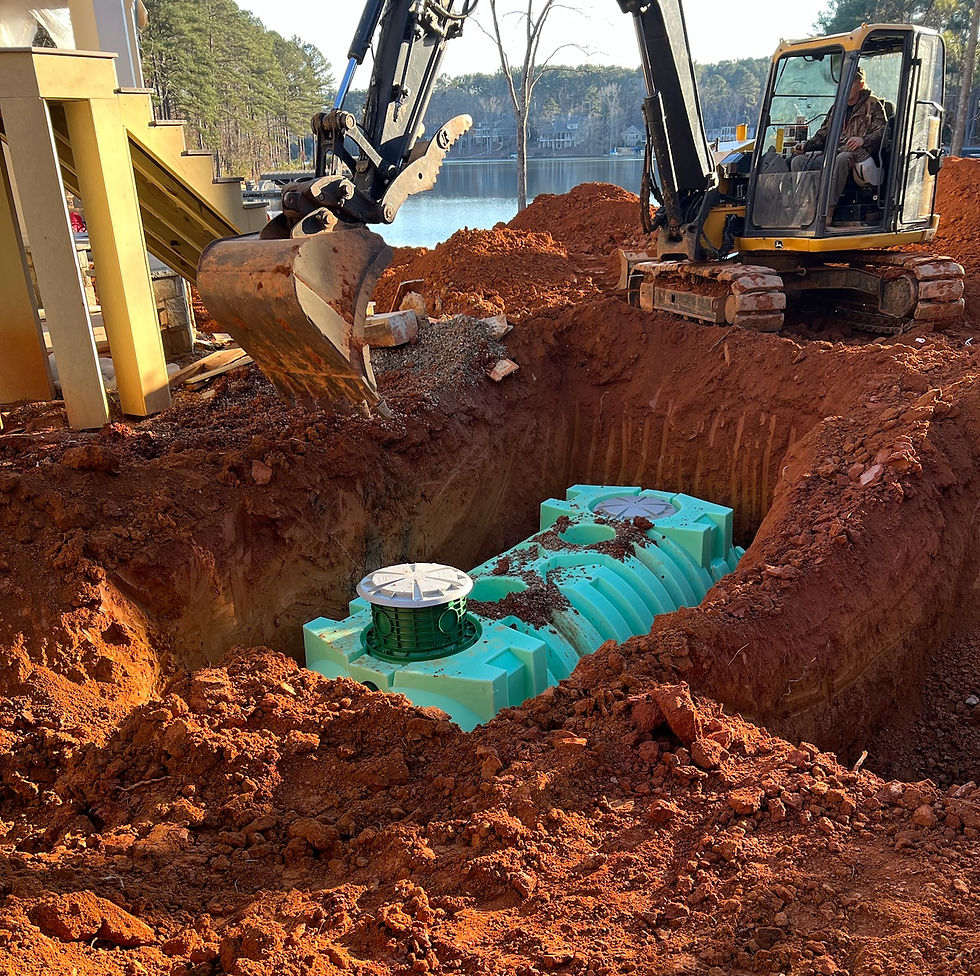
3. Excavation: This is where we come in hard. Tank hole, drain field trenches, any necessary grading. We use equipment sized for residential work so we're not tearing up your yard any more than the job requires. Precision matters here; slope, depth, and spacing on the drain field lines all affect system performance for decades.
4. Tank placement and connection: Concrete or poly tank goes in the ground. Inlet and outlet baffles, access risers, and the effluent line to the drain field all get installed and inspected.
5. Drain field installation: Gravel or chamber systems, depending on design. We set the distribution box, run the laterals at the correct slope and spacing, and backfill carefully to avoid compacting the field.
6. Final inspection and backfill: County inspector signs off before we close everything up. Once it passes, we backfill, rough grade, and the system is live.
How Long Does Septic Installation Take in Georgia?
Short answer: The installation itself takes 1–3 days. The permitting process takes longer.
Most homeowners are surprised to learn that the physical work is the fastest part.
A straightforward 3-bedroom residential system with favorable soil conditions can be excavated, installed, inspected, and closed up in a day or two once we're on-site. What adds time is the front end: soil evaluation scheduling, permit processing at the county, and inspector availability.
Realistic total timeline from first call to finished system:
Site evaluation: 1–5 business days to schedule
Permit processing (Baldwin County): 2–4 weeks typical
Excavation and installation: 1–3 days on-site
Final inspection: Usually the same week as install completion
Total from first call to done: 3–6 weeks in most cases
If your project is on a tight timeline, new construction with a closing date, or a failing system that needs urgent replacement,, call us early. We can often expedite the evaluation and coordinate closely with the health department to keep things moving.
How Much Does a Septic System Cost in Middle Georgia?
Honest answer: it depends on your site, and anyone who quotes you a firm number before seeing your property is guessing. That said, here's a realistic range for standard residential systems in this area:
Conventional gravity-fed system (3-bed home, favorable soil): $4,000 – $8,000 installed
Engineered system (mound, drip, or ATU; clay-heavy soil): $9,000 – $18,000+ depending on system type
Tank only replacement (existing drain field intact): $2,500 – $4,500
Drain field repair or expansion: $3,000 – $8,000 depending on scope
Perc test and site evaluation (third-party evaluator): $300 – $600 typical
Baldwin County permit fee: $200 – $400 typical (varies by system type)
These numbers reflect Middle Georgia market rates as of 2025–2026. Concrete tank vs. poly, distance from the road, site access difficulty, and how much rock we hit all affect the final cost. We give detailed written estimates before any work starts, no surprises on the invoice.
📞 Call (478) 251-5800 to schedule a free on-site estimate. We cover Milledgeville, Eatonton, Gray, Sparta, Sandersville, and surrounding areas.
FAQ: Septic Systems in Milledgeville and Baldwin County
Do I need a permit to install or replace a septic system in Georgia?
Yes, always. Georgia law requires a permit from your county environmental health office for any new septic installation and for most replacement or repair work. No permit means no legal system, and it creates serious problems when you try to sell the property.
Can I install my own septic system in Georgia?
You can, on your own property, but the design still has to be done by a licensed evaluator, and the installation still requires a county permit and inspection. Most homeowners find it's not worth the risk, a failed inspection means digging it all back up.
How do I know if my septic system is failing?
Wet or spongy ground over the drain field, sewage odors in the yard or inside the house, slow drains throughout the home, and sewage backing up into fixtures are all signs. If you're seeing any of these, stop using the system as much as possible and call for an evaluation immediately.
What's the difference between a septic tank and a drain field?
The septic tank is where solids settle and initial treatment happens. The drain field (also called a leach field) is where the liquid effluent gets distributed into the soil for final treatment. Both have to be sized correctly and both can fail independently.
How often should a septic tank be pumped in Georgia?
Every 3–5 years for a typical residential household, depending on tank size and number of occupants. Waiting too long lets solids build up and migrate into the drain field, which is the expensive failure you want to avoid.
Does Area Solutions do septic repair or just new installations?
Both. We handle new installations on undeveloped lots, replacement systems for failing setups, drain field repairs and expansions, and excavation work for septic-related projects across Middle Georgia.
Why Area Solutions for Your Septic Installation
We're not a septic-only company. We're excavation and site development specialists, which means we understand the full scope of what's happening underground on your property: drainage patterns, grade, soil, and utilities. Septic installation isn't a side service for us. It's core to what we do.
Owner Owen Skelly and the team at Area Solutions have worked on residential, agricultural, and commercial properties across Baldwin, Jones, Putnam, Hancock, and Washington counties. We know the local soil conditions, the county health departments, and the engineering challenges specific to this part of Georgia.
We also believe in being straight with clients. If your site is going to need an engineered system, we'll tell you that upfront, not after we've already started digging. If the scope changes, you'll hear about it before it hits the invoice.
Area Solutions · Milledgeville, GA · (478) 251-5800 · areasolutionsga.com
Serving Middle Georgia: Baldwin · Jones · Putnam · Jasper · Hancock · Washington · Wilkinson Counties
Ready to Talk About Your Property?
Whether you're breaking ground on a new build, replacing a failing system, or just trying to understand what's going on under your yard, we're a phone call away. Area Solutions gives free on-site estimates throughout Middle Georgia.
Call (478) 251-5800 or visit areasolutionsga.com


Comments