

Why Middle Georgia's Drought Is Actually the Best Time to Break Ground in 2026
- Ajasa Samuel
- Apr 17
- 6 min read

The ground under your feet is drier than it's been in years. And if you've been putting off a build, a demolition, or a new driveway, that's the first piece of good news you've had in a while
The dirt is talking, and most people aren't listening
Middle Georgia is in a drought. You've probably noticed it without anyone telling you , the lawns went brown early, the pond levels dropped, the red clay in your yard turned to dust when you walked on it. The National Weather Service is calling the 2025–2026 winter recharge season a historic failure. The Oconee, Ocmulgee, and Flint river basins all entered spring below normal. NOAA's April outlook says to expect above-normal temperatures right through June.
Most homeowners hear that and think: bad news for the garden. And sure, it is.
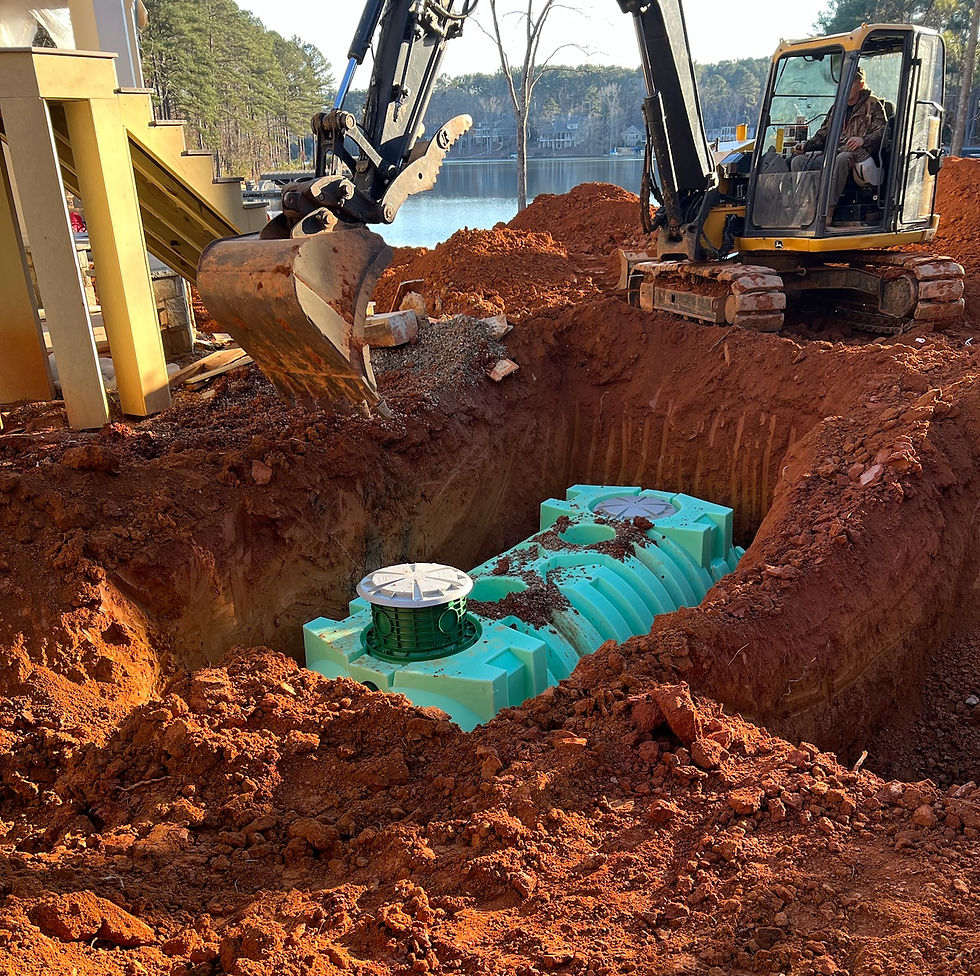
But if you're planning any kind of site work , building pad, driveway, septic system, demolition, or clearing land for a new home , the drought is genuinely working in your favor. Here's why nobody's telling you that, and why it matters more than you think.
Dry ground is stable ground
The single biggest enemy of excavation work in Middle Georgia isn't the soil itself. It's water in the soil. When our Georgia clay gets saturated, it turns into something between pudding and cement. Equipment sinks. Grading work has to be redone. Newly compacted surfaces fail because water pockets get trapped underneath.
Right now, the soil profile across Baldwin, Putnam, Hancock, and the surrounding counties is dry enough to compact properly the first time. That means building pads hold. Driveways hold. Foundation trenches cut clean instead of collapsing. We've been in this work for over fifty years between the crew, and I can tell you plainly: a dry April job looks different from a wet April job. The dry one finishes on time.
If you've ever had a contractor quote you a timeline and then blow past it by two weeks, there's a good chance mud was the reason.
Permits move faster when everyone else is waiting
Here's something the industry doesn't talk about openly. The Baldwin County Environmental Health office on Ireland Drive and the Building Inspections department at 121 North Wilkinson Street both have limited inspector capacity. When spring and summer rain forces every builder in the county to reschedule, permit inspections pile up. Projects stall. A two-week build becomes a five-week build because you spent three weeks waiting for a footing inspection.
Dry weeks are inspection weeks. Inspectors can actually get on site. Soil classifiers can actually run a Level 3 soil report without the percolation variables going sideways. The permit pipeline is moving smoothly right now, and that's a window that typically closes by late May.
Erosion control is simpler , and that saves you real money
Georgia's Erosion and Sedimentation Act requires any disturbance of one acre or more to carry an NPDES permit through the Georgia EPD's GEOS portal. Fees run $40 to $80 per disturbed acre. You file at least fourteen days before work begins. And once you're working, your site has to be stabilized before you close out the project.
In a wet spring, "stabilized" is a moving target. Straw washes out. Silt fence gets undermined. You lay erosion matting, and the next storm rearranges it. Under drought conditions, the straw and matting we put down actually stays put. The seed we apply at project close gets a fighting chance to root before the next real rain. When that rain arrives , and it will , your slopes are already held together.
This is the part most homeowners never see on the invoice. A site that needs erosion remediation costs thousands to fix after the fact. A site that stabilized cleanly the first time just costs what the original quote said.

The demolition math also works in your favor
If you've got a structure on your property that needs to come down , a fire-damaged house, a collapsed outbuilding, a shed that's become a hazard , drought conditions matter here too. Demolition is a dust-heavy process, and water trucks have to work harder in summer to control airborne particles. But the real issue is the debris hauling. Loaded dump trucks on saturated ground tear up driveways, rut easements, and sometimes get stuck. Dry conditions keep them moving.
We just completed a project on a fire-damaged home in the area where every phase , demolition, hauling, grading, erosion control with straw , went in and came out without a single weather delay. That's not a coincidence. That's the window we're in right now.
What the forecast is telling us about the next four months
The Old Farmer's Almanac spring outlook says April will be drier than usual across the Southeast, with May turning slightly wetter. NOAA's Climate Prediction Center agrees on the temperature side: above-normal through June. That gives you roughly four to six weeks of ideal ground conditions for site work before the weather pattern probably shifts.
If you're reading this in April, you have maybe six weeks to get ahead of the curve. If you're reading this in May, you have three. By late summer, two things will be true: either the drought continues , which starts creating its own problems with dust, wildfire risk, and stressed vegetation , or the pattern breaks and the whole county is scrambling to resume postponed projects.
What to do this week if you've been putting off a project
If you've had a site prep, demolition, septic, or driveway project on the mental back burner, here's what I'd do right now:
Walk the property in the morning. Look for areas where the ground has cracked, where grading has shifted, where drainage paths have developed during the dry months. These are the things you want to address before the rains return.
Get your soil evaluation scheduled. If you're planning a new septic or a building pad, a Level 3 soil report is required before permitting , and the Georgia Department of Public Health updated the full septic manual in March 2026. The soil classifier backlog is lighter right now than it will be in June.
Pull the permits you'll need. Baldwin County requires permits for any work valued over $1,000. The office on North Wilkinson Street is processing applications in the normal 24 to 48 hour window right now. That changes once storm season starts and everyone calls at once.
Book the crew. Middle Georgia site development companies are booking spring projects three to six weeks out. If you want work done before the end of May, the conversation needs to happen this week.

The thing the drought doesn't fix
One honest note. Drought doesn't make everything easier. If your septic system has been under stress , slow drains, patches of unusually green grass over the drain field, unexplained odors , dry conditions can mask symptoms that return the moment rainfall does. If you've noticed anything off about your system, this is the time to get eyes on it. Not after the rain comes back.
And some site conditions don't care about the weather. Clay that's already saturated from last year's rain holds water for months. Low spots on your property that have persistent drainage issues need grading and French drains, regardless of what the sky is doing.
The point isn't that drought is good. The point is that right now, for a narrow window, the ground in Middle Georgia is easier to work with than it will be for most of the next year. If you've been waiting for the right time to start a project, this is probably it.
The best time to plant a tree was twenty years ago. The second-best time is today. Site prep works the same way.
One call. Free assessment. No obligation for site prep Middle Georgia drought
We've been doing site dev,elopment work across Baldwin, Putnam, Hancock, Washington, Wilkinson, Jones, and Laurens Counties for over fifty combined years between the crew. We know the soil. We know the county inspectors. We know what your project is actually going to cost before we walk your property, and we'll give you a straight answer about whether right now is the right time or whether you should wait.
That assessment is free. It takes about an hour. And if we don't think your project makes sense this season, we'll tell you that too.
Ready to take advantage of the conditions? Call Area Solutions; (478) 251-5800areasolutionsga.com


Comments