

Will your soil pass? Georgia dirt and the septic perc test

Buy rural land in Middle Georgia and at some point somebody says the words "perc test," usually in a tone that suggests you should be worried.
You should be interested, at least. The soil under your proposed drain field determines whether you can build at all, what kind of septic system you can have, how large it needs to be and what it costs. Two lots on the same road can return completely different answers.
What type of soil is Georgia known for
Red clay, and the reputation is earned.
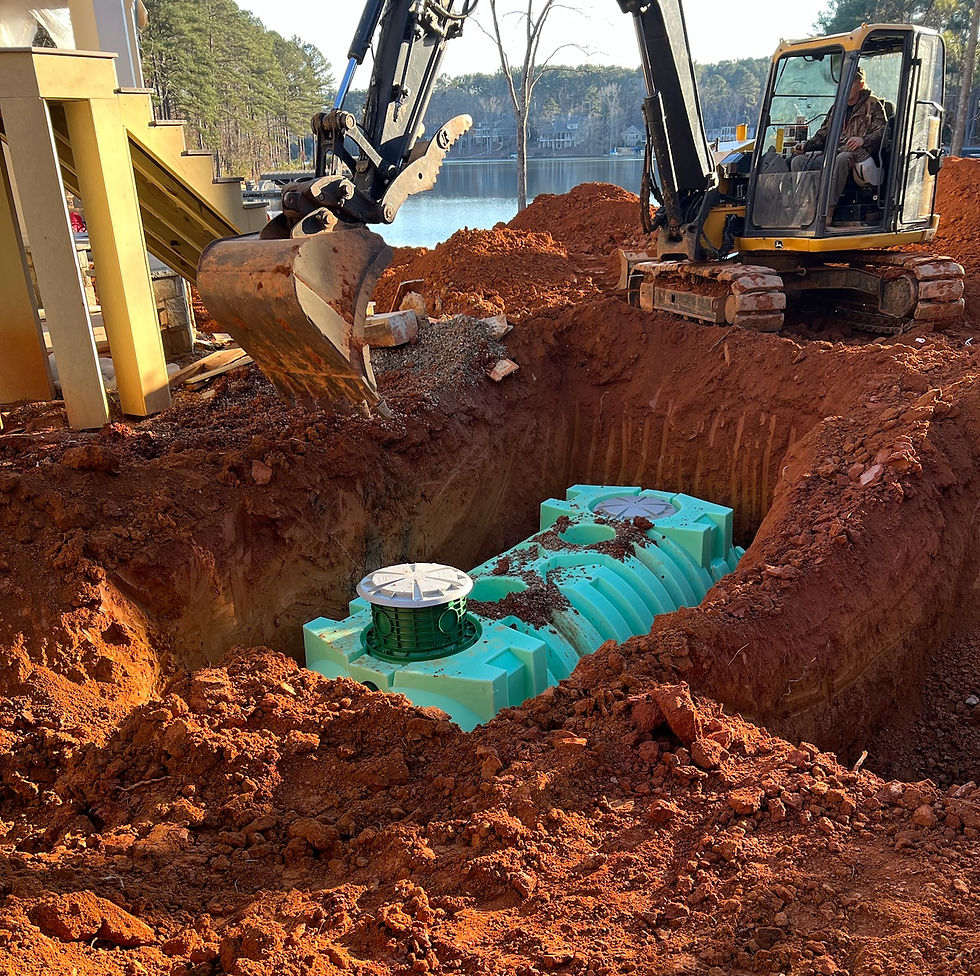
Across the Piedmont, which runs through central Georgia from roughly Atlanta down to Augusta, the dominant soil is the Cecil series and its relatives. It formed in place from weathered granite and similar rock, and the red comes from iron oxides left behind after millions of years of weathering. Underneath sits saprolite, the soft rotted rock the clay came from, which erodes fast once you strip the trees off it.

South of the Fall Line, which runs more or less through Milledgeville, Macon and Columbus, everything changes. The Coastal Plain was seabed. Its soils formed in marine sediment and they are sandy where the Piedmont is clayey. Georgia's official state soil, Tifton, sits down here: a loamy sand topsoil over sandy clay loam subsoil, with ironstone nodules near the surface and plinthite deeper down. It carries a large share of the state's prime farmland.
Which means Baldwin County and the counties around it sit right on the seam. You can find heavy Piedmont clay on one property and much sandier Coastal Plain material a few miles away. That is a real reason not to assume your neighbor's septic answer applies to your lot.
Further out, north Georgia has thin acidic mountain soils over metamorphic rock, and the northwest corner has the Limestone Valley with its ridge and valley alternation of sandstone and limestone. Neither concerns most of our customers, but it explains why statewide septic advice is close to useless.
What the evaluation is actually looking for
A soil evaluation for septic is not a single number. Somebody digs or bores into the proposed field area and reads the soil profile, and they care about four things.
Texture, meaning the proportions of sand, silt and clay. Sand drains fast, clay drains slowly, and loam sits in the middle. This is why loamy soils are the ones everybody wants for a drain field.
Structure, meaning how the particles are aggregated. Two soils with identical texture can behave differently depending on whether the clay is in blocky peds with cracks between them or a massive structureless slab.
Depth to a restrictive layer. Bedrock, saprolite, a hardpan or a dense layer that water will not move through. If that layer sits close to the surface, you do not have enough soil above it to treat wastewater before it hits the restriction and runs sideways.
Depth to seasonal high water table. Soil that saturates in February looks perfectly fine in August. Evaluators read this from redoximorphic features, the gray and orange mottling that marks soil which spends part of the year underwater.
Get all four in good shape and you have a conventional gravity drain field. Fall short on one and the answer becomes a larger field, a different system type, or no.
Why clay is harder than people assume, and sand is not automatically better
Clay is the one people worry about, correctly. Water moves slowly through it. A drain field in heavy clay needs more trench length to disperse the same daily flow, and it is less forgiving of hydraulic overload. Piedmont Cecil soils are actually better than their reputation, because they are deep and well drained with moderately high conductivity, but a poorly structured clay with a shallow restrictive layer is a genuine problem.
Sand cuts the opposite way and surprises people. Effluent that moves through soil too fast does not get treated. The bacteria that do the work need contact time, and in very coarse sand the water is past them before much has happened. Coastal Plain sites sometimes fail for permeability being too high, not too low.
The other Coastal Plain complication is plinthite, the iron-rich material in Tifton and related soils that hardens irreversibly once it dries and wets repeatedly. A plinthic layer can act as a restriction.
About that soil series you found online
If you have been searching soil names and landed on something like Lima gravelly silt loam, note that Lima is a New York soil. It formed in glacial till over limestone and calcareous shale on till plains, and the last glacier that could have put it there stopped a long way north of Georgia. It is not in your county soil survey.
The general lesson holds though. Look up your property in the USDA Web Soil Survey, and you get a map unit name and a septic suitability rating, and that is genuinely useful for screening land before you buy. What it is not is a permit. Those maps are drawn at a scale that smooths over exactly the variation that matters on a one-acre drain field. Your county requires an evaluation on the actual site for a reason.

If the site fails
A conventional gravity field is the cheapest option, so failing that test means moving up in cost rather than being out of options entirely. Depending on what the soil showed, the alternatives include a larger conventional field, a pumped and dosed system distributing effluent evenly across a wider area, subsurface drip dispersal, or a mound system built up above the natural grade where depth to water table or restriction is the limitation.
Sometimes the fix is simply a different part of the property. We have had sites where the obvious spot beside the house failed and an area two hundred feet away passed without difficulty.
One thing worth saying to anybody about to close on raw land: do the soil work before you buy, not after. A failed evaluation discovered afterward turns a cheap lot into an expensive one, and occasionally into an unbuildable one.
Before you commit to a piece of land
Area Solutions works across Middle Georgia on both sides of the Fall Line and deals with Piedmont clay and Coastal Plain sand routinely. If you are evaluating a property and want to know what it will take, call Owen at (478) 251-5800.


Comments